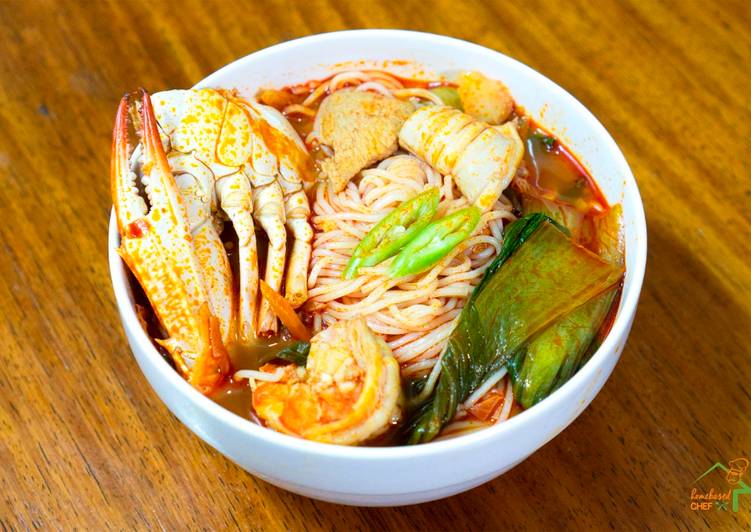
Hello everybody, hope you are having an incredible day today. Today, I will show you a way to prepare a special dish, jjampong (korean spicy seafood noodle soup). One of my favorites. For mine, I’m gonna make it a bit tasty. This will be really delicious.
Jjampong (Korean Spicy Seafood Noodle Soup) is one of the most well liked of recent trending foods in the world. It’s simple, it’s fast, it tastes yummy. It is enjoyed by millions every day. Jjampong (Korean Spicy Seafood Noodle Soup) is something which I have loved my entire life. They’re fine and they look fantastic.
Jjamppong / Jjampong (짬뽕) is a popular Korean spicy noodle soup that is loaded with various type of seafood. It tastes very refreshing and comforting! Every now and then I have a craving for Jjamppong (Korean spicy seafood noodle soup).
Simple Way to Prepare Jjampong (Korean Spicy Seafood Noodle Soup)
To begin with this recipe, we have to prepare a few components. You can have jjampong (korean spicy seafood noodle soup) using 21 ingredients and 7 steps. Here is how you can achieve it.
Ingredients
The ingredients needed to make Jjampong (Korean Spicy Seafood Noodle Soup):
- Take 1 bunch Bokchoy
- Prepare 120 grams Chicken Breast
- Take 6 cloves Garlic
- Make ready 1 inch Ginger
- Prepare 4 stalks Onion Leeks
- Prepare 1/4 head Cabbage
- Make ready 1 piece White Onion
- Take 1/2 piece Carrot
- Make ready 1/2 piece Zucchini
- Make ready 4 tablespoons Cooking Oil
- Take 4 tablespoons Gochugaru
- Take 2 tablespoons Soy Sauce
- Prepare 2 teaspoons Oyster Sauce
- Prepare 6 cups Water
- Prepare 1/4 cup Cooking Wine
- Prepare 1 teaspoon Sesame Oil
- Take 2 pieces Squid
- Make ready 2 pieces Prawns
- Get 1 piece Crab
- Take 2 bundles Somen Noodles
- Take Water for boiling
Seen in the hit Korean drama series It's Okay to Not Be Okay, Jjamppong is a spicy seafood noodle soup that packs a punch. And while the title of this K-Drama holds true, one slurp of these noodles will infinitely perk you up and have you feeling more than just okay. Flavored with chicken stock, rich slices of pork belly and mussels, the wholesome broth is given a spicy kick with the. Jjamppong (also spelled jjambbong) is a spicy noodle soup, and it's one of the two most popular Korean-Chinese dishes alongside jajangmyeon (짜장면, noodles in a black bean sauce).
Instructions
Steps to make Jjampong (Korean Spicy Seafood Noodle Soup):
- PREPARE THE CHICKEN AND THE VEGETABLES - Slice the chicken breast thinly. Chop the garlic and ginger finely. Chop the onion leeks thinly or cut it into strips. - Slice the white onion and the cabbage. Cut the root end of the bokchoy and wash well to remove the dirt. Julienne-cut the carrot and zucchini. - To do the julienne-cut: slice the vegetable diagonally into long sticks then into strips.
- PREPARE THE SEAFOOD - For the crab, remove the cover and the gills then cut the meaty side into two. - For the prawns, remove the head and shellthen de-vein the prawns by making an incision on its back. - For the squid, remove the head including the ink sac and innards. Peel the skin and cut it vertically on one side to make it flat. Then make a criss-cross incisions on the front and back sides. - Wash the seafood under running water.
- COOKING INSTRUCTIONS - Under low heat, heat the wok or large skillet and add 4 tablespoons of cooking oil. Add the garlic, ginger, onion leeks and let them infuse their flavors into the oil. Turn up the heat to high. Add the chicken and vegetables (except for the bokchoy) then stir fry until the chicken turns white.
- Add the gochugaru and stir fry for a minute. Add 2 tablespoons of soy sauce around the wok or skillet (not directly to the vegetables) and 2 teaspoons of oyster sauce. Continue to stir fry for 30 seconds. Pour 6 cups of water and 1/4 cup of cooking wine. Bring to boil and boil for 5 minutes.
- While the soup base is boiling, cook the somen noodles according to package instructions. Somen noodles are thin and will take just a few minutes to cook when placed in boiling water. Boil the noodles, drain, and rinse under cold water. You may also soak it in ice water to stop cooking and then drain later before adding to the jjampong soup.
- Add the crab into the soup and boil for 5-10 minutes depending on how big the crab is. When the crab is already cooked, add the squid, prawns, bokchoy, and sesame oil. You can adjust the seasoning if needed, according to your preference. Continue boiling until the squid and shrimp is cooked completely (about 5-8 minutes).
- PLATING - Add the noodles neatly into the center of the bowl. Pour the soup and arrange the seafood around the noodles. Top with chili and onion leeks. Serve hot.
Often times, Koreans have a hard time choosing between the two when eating out. Place noodles in a serving bowl nicely. Put some kind of fancy ingredients such as shrimp or squid in the center and put the mussels around them. Today, I showed you how to make Jjamppong, Korean spicy seafood noodle soup. Now, it's time to say goodbye to some kind of strange home-made seafood soup!
As simple as that Guide to Prepare Jjampong (Korean Spicy Seafood Noodle Soup)
So that’s going to wrap this up for this exceptional food jjampong (korean spicy seafood noodle soup) recipe. Thank you very much for your time. I am confident you can make this at home. There’s gonna be more interesting food in home recipes coming up. Don’t forget to save this page in your browser, and share it to your loved ones, colleague and friends. Thanks again for reading. Go on get cooking!
Print this page